List of African Countries: All 54 Countries and Capitals
Africa has 54 sovereign countries, all members of the United Nations. They range from Algeria, the largest (about 2.38 million km²), to Seychelles, the smallest (459 km²), and from Nigeria, with about 238 million people, to Seychelles, with about 130,000. Together they cover about 30.3 million km² and are home to over 1.4 billion people. Below you will find a map of Africa's countries, an A–Z list of all 54 with their capitals and regions, and the countries grouped by region.
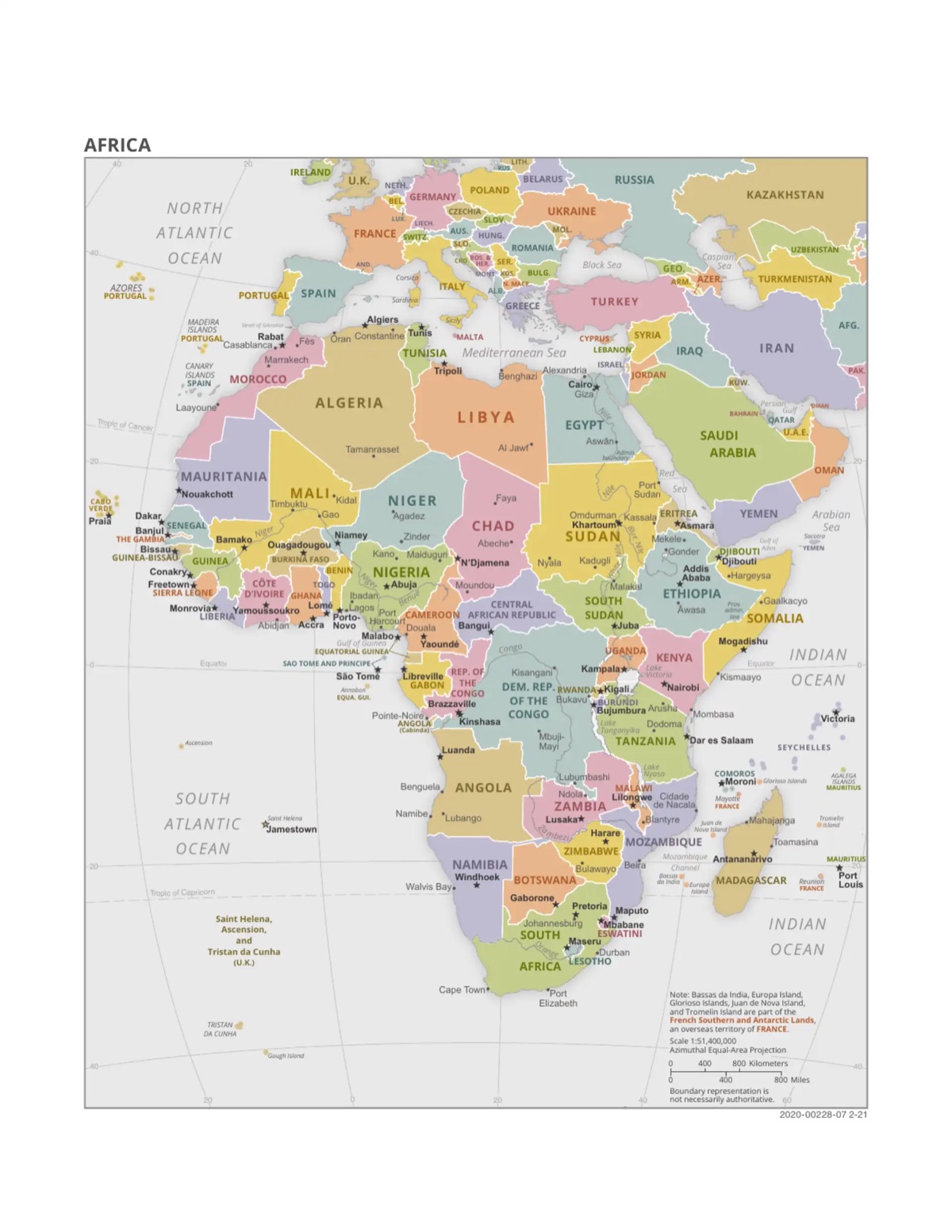
A–Z List of the 54 African Countries
All 54 countries in alphabetical order, with their capital and region (United Nations geoscheme). Where a country has more than one capital or its largest city is better known, both are shown.


Not included: Western Sahara is a disputed territory, mostly administered by Morocco and claimed by the Sahrawi Arab Democratic Republic; it is not one of the 54 UN member states. Overseas territories such as the Canary Islands, Madeira, Réunion, Mayotte and Saint Helena belong to European countries.
African Countries by Region
This grouping follows the United Nations geoscheme: North Africa (6 countries), West Africa (16), Central or Middle Africa (9), East Africa (18) and Southern Africa (5). Other definitions exist; for example, Mauritania is often grouped with North Africa (the Maghreb), and Zambia, Zimbabwe, Malawi and Mozambique are usually counted as Southern Africa.
North Africa (6 countries)
Mediterranean coast and the Sahara, with Arab and Amazigh (Berber) cultures. Includes Africa's largest country, Algeria, and Egypt, which extends into Asia through Sinai.
West Africa (16 countries)
From the Sahel to the Gulf of Guinea rainforests; home to Africa's most populous country, Nigeria, and to the historic empires of Ghana, Mali and Songhai.
Central Africa (Middle Africa) (9 countries)
The Congo Basin rainforest and surrounding savannas, including Africa's second-largest country, DR Congo.
East Africa (18 countries)
The Horn of Africa, the Great Rift Valley, the Great Lakes, the Indian Ocean islands and, in the UN scheme, Zambia, Zimbabwe, Malawi and Mozambique.
Southern Africa (5 countries)
In the UN scheme, the five countries of the Southern African Customs Union. In everyday use (and in SADC) the term usually also covers Angola, Zambia, Zimbabwe, Malawi and Mozambique.
Africa's Countries in Numbers
Sovereign countries
People
Square kilometres
Landlocked countries
Largest, smallest and most populous
- Largest country: Algeria (2,381,741 km², about 8% of Africa)
- Second largest: DR Congo (2,344,858 km²)
- Smallest country: Seychelles (459 km²); smallest on the mainland: The Gambia
- Most populous: Nigeria (about 238 million people, 2025 UN estimate)
- Least populous: Seychelles (about 130,000 people)
- Most densely populated: Mauritius (over 600 people per km²)
- Least densely populated: Namibia (about 4 people per km²)
More rankings: largest countries by area, most populous countries, richest countries.
Geography at a glance
- Landlocked countries: 16 African countries have no coastline – more than on any other continent (see the list).
- Island countries: 6 – Cabo Verde, São Tomé and Príncipe, Madagascar, Mauritius, Comoros and Seychelles (see the list).
- On the equator: Gabon, Republic of the Congo, DR Congo, Uganda, Kenya and Somalia, plus the islet of Rolas in São Tomé and Príncipe.
- Transcontinental: Egypt extends into Asia through the Sinai Peninsula.
- Newest country: South Sudan, independent since 9 July 2011.
- Highest point: Mount Kilimanjaro, Tanzania (5,895 m). Lowest point: Lake Assal, Djibouti (−155 m).
Continental extremes
- Northernmost point: Ras ben Sakka, Tunisia (37°21′N)
- Southernmost point: Cape Agulhas, South Africa (34°50′S)
- Westernmost point: Santo Antão, Cabo Verde (about 25°22′W); on the mainland, Pointe des Almadies, Senegal
- Easternmost point: Ras Hafun, Somalia (51°24′E)
Natural features shared by several countries
- Sahara Desert: the world's largest hot desert, spread across about ten countries.
- Nile: one of the world's two longest rivers; its basin covers 11 countries (Nile on the map).
- Congo Basin: the world's second-largest tropical rainforest, shared mainly by DR Congo, the Republic of the Congo, Cameroon, Gabon, the Central African Republic and Equatorial Guinea.
- Great Rift Valley: runs from the Red Sea through Ethiopia and Kenya to Mozambique.
- Victoria Falls: on the Zambezi between Zambia and Zimbabwe.
- Okavango Delta: a vast inland delta in Botswana.
Languages Across African Countries
More than 2,000 languages are spoken in Africa – roughly a third of the world's total. Most countries have one or more official languages inherited from the colonial period alongside many local languages; others give official status to African languages such as Kiswahili, Amharic, Kinyarwanda, Setswana or Sesotho.
- English: official in about 24 countries, mainly in East, West and Southern Africa (list).
- French: official in about 20 countries, mainly in West and Central Africa (list). Mali, Burkina Faso and Niger have recently downgraded French to a working language.
- Arabic: official in about 11 countries, mostly in North Africa and the Horn (list).
- Portuguese: official in 6 countries – Angola, Mozambique, Cabo Verde, Guinea-Bissau, São Tomé and Príncipe and Equatorial Guinea (list).
- Spanish: official only in Equatorial Guinea.
- Kiswahili: official in Tanzania, Kenya, Uganda and Rwanda, and a national language of DR Congo.
The main language families are Niger–Congo (including the Bantu languages), Afroasiatic (Arabic, Amazigh, Amharic, Somali, Hausa), Nilo-Saharan, the Khoisan click languages of southern Africa, and Austronesian (Malagasy in Madagascar).
Economies of African Countries
By nominal GDP, the largest African economies in recent IMF estimates are South Africa, Egypt, Algeria, Nigeria and Morocco; their order changes from year to year with exchange rates (Nigeria fell from first place after the naira was devalued in 2023–2024). By GDP per head, small economies such as Seychelles and Mauritius rank highest.
- Oil and gas: Nigeria, Angola, Algeria, Libya, Egypt, Equatorial Guinea, Gabon, Republic of the Congo
- Mining: South Africa, DR Congo (cobalt, copper), Zambia (copper), Ghana (gold), Botswana (diamonds), Guinea (bauxite)
- Agricultural exports: Côte d'Ivoire and Ghana (cocoa), Ethiopia (coffee), Kenya (tea, flowers)
- Tourism: Egypt, Morocco, South Africa, Tunisia, Kenya, Tanzania, Mauritius
- Financial services: South Africa, Nigeria, Kenya, Morocco, Egypt, Mauritius
See also: richest countries in Africa and poorest countries in Africa.
History: From Ancient Kingdoms to Independence
Africa is where humans first evolved, and many modern countries sit on the lands of ancient states:
- Ancient Egypt (modern Egypt), Kush (Sudan), Carthage (Tunisia) and Aksum (Ethiopia and Eritrea)
- Ghana Empire (Mauritania and Mali), Mali Empire (Mali, Senegal, Guinea and neighbours) and Songhai (Mali, Niger), one of the largest African empires
- Kanem–Bornu (Chad, Nigeria, Niger), Great Zimbabwe (Zimbabwe) and the Kingdom of Kongo (Angola, DR Congo, Republic of the Congo)
After the Scramble for Africa of the late 19th century, almost the whole continent was under European rule; only Ethiopia (apart from the Italian occupation of 1936–1941) and Liberia stayed independent. Most countries won independence between 1956 and 1975:
- Early independence: Egypt (1922), Libya (1951), Sudan, Morocco and Tunisia (1956), Ghana (1957) and Guinea (1958)
- 1960, the "Year of Africa": 17 countries became independent, including Nigeria, DR Congo, Senegal and Madagascar
- Portuguese colonies: Guinea-Bissau (1973–74), Mozambique, Cabo Verde, São Tomé and Príncipe and Angola (1975)
- Latest: Zimbabwe (1980), Namibia (1990), Eritrea (1993) and South Sudan (2011)
More: African independence timeline and colonial map of Africa.
Climate Zones
Africa straddles the equator, so its climate zones are roughly mirrored north and south:
- Mediterranean: the North African coast (Morocco, Algeria, Tunisia, northern Libya and Egypt) and the south-western tip of South Africa
- Desert: the Sahara in the north and the Namib and Kalahari in the south-west
- Semi-arid Sahel: the belt south of the Sahara from Senegal and Mauritania to Sudan and Eritrea
- Tropical savanna: much of West, East and Southern Africa
- Tropical rainforest: the Congo Basin and the Gulf of Guinea coast
- Highland climates: the Ethiopian Highlands, East African plateaus and Lesotho
Travelling Between African Countries
- Visas: rules vary widely. Several countries, including Rwanda, Benin, The Gambia and Seychelles, let all African citizens visit without a visa, and many others offer e-visas or visas on arrival. Check our visa requirements page.
- Regional free movement: ECOWAS citizens can move freely between its member states in West Africa (Mali, Burkina Faso and Niger left the bloc in January 2025). The East Africa Tourist Visa covers Kenya, Uganda and Rwanda.
- Best seasons: North Africa October–April; East African safaris June–October; Southern Africa May–October; West Africa November–February.
Africa in International Organisations
- African Union: 55 members – the 54 countries plus the Sahrawi Arab Democratic Republic.
- United Nations: the 54 African states make up more than a quarter of UN members.
- Regional blocs: ECOWAS, SADC, the East African Community (EAC), ECCAS/CEMAC and the Arab Maghreb Union; the African Continental Free Trade Area (AfCFTA) links most of the continent.
- BRICS: South Africa, Egypt and Ethiopia are members.
- Commonwealth: 21 African members, including former non-British colonies Mozambique, Rwanda, Gabon and Togo.
African Countries: Frequently Asked Questions
How many countries are there in Africa?
Africa has 54 sovereign countries that are members of the United Nations. Western Sahara is a disputed territory and is not counted among them, although the Sahrawi Arab Democratic Republic is a member of the African Union, which therefore has 55 members.
What is the largest country in Africa?
Algeria is the largest country in Africa by area, at about 2.38 million km². It is followed by DR Congo (about 2.34 million km²), Sudan, Libya and Chad.
What is the smallest country in Africa?
Seychelles is the smallest African country, at about 459 km². The smallest country on the African mainland is The Gambia, at about 11,300 km².
Which African country has the most people?
Nigeria is the most populous country in Africa, with about 238 million people (2025 UN estimate). Ethiopia (about 135 million), Egypt and DR Congo follow.
What was the last African country to become independent?
South Sudan, which separated from Sudan on 9 July 2011, is Africa's newest country. Eritrea became independent from Ethiopia in 1993.