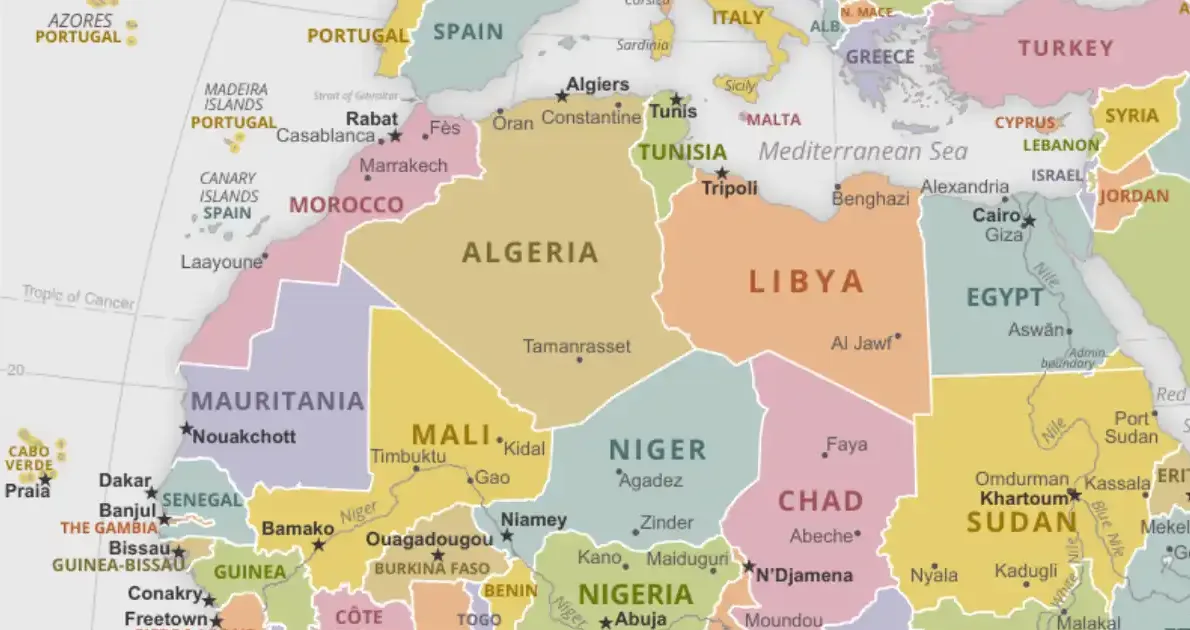
About North Africa
Geography & Climate
North Africa is dominated by the Sahara Desert, the world's largest hot desert. The region features diverse landscapes including:
- The Nile River Valley: Supporting one of the world's oldest civilizations in Egypt
- Atlas Mountains: Stretching across Morocco, Algeria, and Tunisia
- Mediterranean Coast: Fertile coastal plains with a Mediterranean climate
- Sahara Desert: Covering most of the region's interior
Culture & Languages
North Africa is predominantly Arabic-speaking and Muslim, though indigenous Berber (Amazigh) populations and languages remain significant, especially in Morocco and Algeria, where Tamazight is an official language alongside Arabic. French is widely used in business and education in the Maghreb, and English is co-official in Sudan. The region is part of the broader MENA (Middle East and North Africa) cultural sphere.
History
North Africa boasts some of humanity's oldest civilizations:
- Ancient Egypt: Pyramids, pharaohs, and 5,000 years of recorded history
- Carthage: Powerful ancient civilization in modern Tunisia
- Roman Africa: Major province of the Roman Empire
- Islamic Caliphates: Centers of learning and culture during the Middle Ages
- Colonial Period: France ruled Algeria (from 1830), Tunisia and most of Morocco; Britain controlled Egypt and, with Egypt, Sudan; Italy held Libya; Spain held zones of northern and southern Morocco
- Independence: Egypt (1922, fully sovereign later), Libya (1951), Sudan, Morocco and Tunisia (1956), Algeria (1962) after an eight-year war
Economy
The region's economy is driven by:
- Oil & Gas: Algeria and Libya are major petroleum producers
- Tourism: Ancient monuments, beaches, and cultural heritage sites
- Agriculture: Dates, olives, citrus fruits in coastal regions
- Suez Canal: Egypt's vital global shipping route
- Phosphates: Morocco (including Western Sahara) holds about 70% of the world's known phosphate rock reserves
Major Cities
- Cairo, Egypt: Africa's largest urban area (about 22 million in the metro area)
- Alexandria, Egypt: Historic Mediterranean port city
- Casablanca, Morocco: Economic capital and largest port
- Algiers, Algeria: Capital and cultural center
- Tripoli, Libya: Capital and largest city
- Tunis, Tunisia: Capital and historic center
- Khartoum, Sudan: Capital at the confluence of the Blue and White Nile, heavily damaged in the war that began in 2023
UNESCO World Heritage Sites
North Africa contains numerous UNESCO sites including:
- Pyramids of Giza (Egypt)
- Ancient Thebes with Luxor & Karnak (Egypt)
- Medina of Fez (Morocco)
- Kairouan (Tunisia)
- Timgad Roman ruins (Algeria)
- Archaeological Site of Leptis Magna (Libya)
The Maghreb
The western part of North Africa (Morocco, Algeria, Tunisia, Libya, and sometimes Mauritania) is known as the Maghreb (Arabic for "the West"). These countries share close cultural, linguistic, and historical ties.
Sudan and Western Sahara
Sudan is counted in North Africa by the UN, although it is often grouped with East Africa or the Sahel. Since April 2023 it has been in a civil war between the Sudanese Armed Forces and the Rapid Support Forces, one of the world's largest displacement crises. Western Sahara is a disputed territory, largely administered by Morocco and claimed by the Sahrawi Arab Democratic Republic; it is not counted among Africa's 54 countries.